
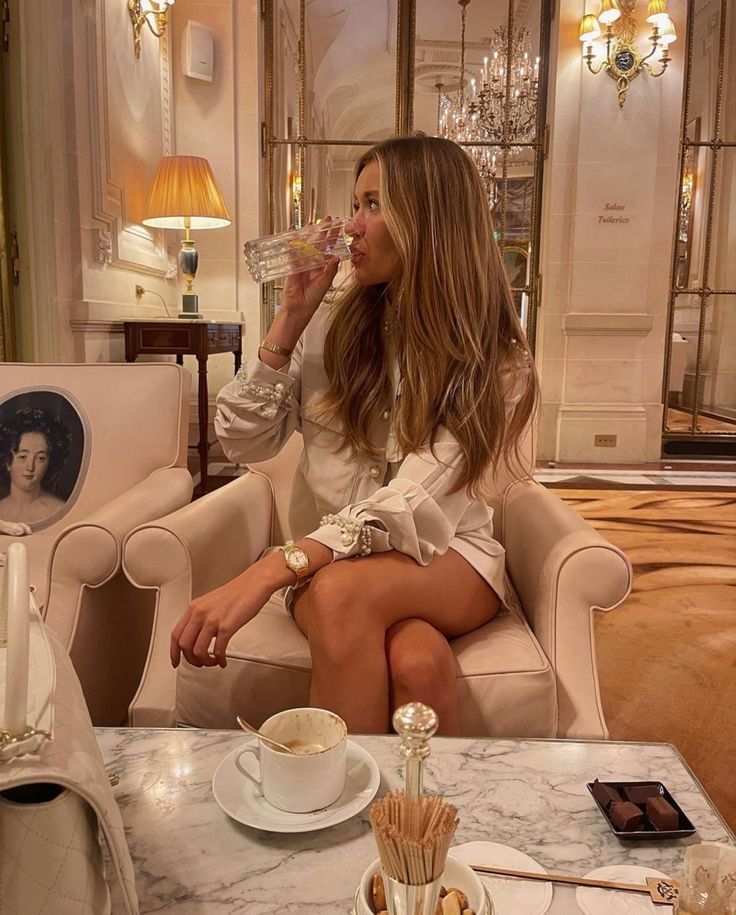
Poise is one of the most misunderstood feminine qualities. Modern culture treats it as a surface trait — posture, grooming, etiquette, polished movement. But true poise does not come from training alone. Its origins are much deeper and more ancient. When a woman moves with unusual steadiness, carries herself with a certain quiet gravity, or simply inhabits a room with grace that feels both understated and undeniable, she is not performing elegance. She is enacting a kind of ancestral choreography written into her nervous system long before she learned to walk.
Poise is inherited more often than it is taught. It passes through families the way temperament does — subtly, silently, through the atmosphere of childhood and the patterns of behavior absorbed from the adults who raised you. A woman whose mother moved through the world with deliberateness often absorbs the same deliberateness. A woman who grew up watching relatives speak with restraint internalizes that restraint. A girl who saw her elders resolve conflict with calm tones learns that calm is an instinct, not a technique.
This is why some women enter adulthood with an almost instinctive grace, while others must create it from scratch. And this is also why poise feels so different from the “elegance” that online spaces try to teach. True poise is not the result of etiquette lessons or posture correction. Those can refine what is already present. They cannot fabricate the underlying foundation.
The foundation is ancestral.
Poise as a Nervous System Inheritance
Every family has a certain emotional rhythm. Some have a pattern of rushing — quick speech, fast reactions, constant multitasking. Others operate with quiet pacing — measured tone, long pauses, unhurried decisions. Children absorb these rhythms directly into their nervous systems. By the time a girl reaches adolescence, the pace of her presence has already been shaped by the home that raised her.
Women who seem naturally poised often grew up in environments where movement was not frantic, where adults modeled emotional containment, and where life unfolded with a sense of continuity rather than crisis. They learned, without ever being told, that there is time — time to speak, time to think, time to choose. Their bodies carry this message forward into adulthood.
Others did not grow up with this embodied sense of time. Their childhoods were shaped by instability or urgency, where efficiency was prized over elegance and where emotional eruptions had to be managed rather than witnessed with calm. These women learned to move quickly because quickness was adaptive. To pause felt risky. To slow down felt indulgent. To stand still felt unsafe.
The difference between these two internal landscapes becomes visible in the way a woman occupies space.
Poise is not a skill of the body — it is the memory of a regulated nervous system.
Why Some Women Look Effortlessly Refined
There is a misconception that elegance belongs exclusively to the wealthy. But the external world only mirrors what the internal world allows. Women who appear effortlessly refined are not refined because of their socioeconomic background; they are refined because they were raised in atmospheres that normalize containment.
Containment is not withholding emotion — it is managing it with a sense of proportion. It is knowing how to speak without spilling, how to express without overwhelming, how to react without fracturing the environment around you. When this is modeled from a young age, it seeps into a woman’s instincts. She becomes fluent in the subtle art of emotional proportion, which is the true signature of poise.
In homes where adults expressed emotions in calibrated, orderly ways, children learn that emotional storms are not inevitable. They learn that silence is not punishment. They learn that pauses are part of conversation. They learn that anger does not require spectacle and joy does not require chaos.
By adulthood, this embodied calm reads as grace.
The Social Dimension of Poise
Poise also has a social dimension. It is a form of relational intelligence — the ability to read a room without bending to it, to engage without performing, to contribute without dominating. Women raised in well-socialized or cultivated families learn the nuances of presence through constant exposure. They observe how adults lower their voices when entering a space, how they offer attention rather than demand it, how they use their words sparingly but precisely.
The poised woman does not behave this way because she studied etiquette manuals. She behaves this way because she grew up in an environment where such behavior was the norm. Her “social grace” is not a persona — it is muscle memory.
Women who were not exposed to these environments often interpret poise as a theatrical performance: stand straight, speak neatly, smile gently, control the hands. But these external elements only emerge naturally when the internal rhythm is stable. Without the inner foundation, the outer performance feels stiff, hesitant, or overly deliberate.
True poise does not announce itself.
It appears in the way a woman moves, not in what she tries to project.
Poise Is Not Personality — It Is Emotional Architecture
One of the greatest misunderstandings is believing that poised women are naturally calm or reserved. Many of them are not. Some are lively, humorous, deeply expressive. Their poise comes from structure, not from temperament. They have inherited or learned a way of organizing their emotional responses so that nothing feels excessive or misaligned with their own dignity.
A poised woman can be animated without being chaotic. She can express passion without tipping into volatility. She can articulate a boundary without raising her voice or escalating her energy. She can express her needs without defensiveness.
This is not because she lacks emotion — but because she has internalized a sense of proportion. Her emotions do not override her presence. Her presence holds her emotions.
This internal order is not innate; it is taught through lineage, modeled through environment, or cultivated through personal refinement.
Why Poise Feels Exclusive (and Why It Shouldn’t Be)
Because poise is so rarely cultivated in modern life, it has come to feel elitist — reserved for those who grew up with privilege, private education, or extended generational stability. But poise is not class-specific. It is environment-specific.
In today’s world, most environments are overstimulating, loud, unregulated, and overly reactive. Many women have never experienced calm long enough for their nervous systems to calibrate to it. They have never seen adults resolve conflict with quiet dignity, never seen boundaries delivered as simple statements rather than confrontations, never lived in an atmosphere where time feels spacious rather than compressed.
Poise appears rare because the conditions that create it are rare.
But any woman can learn poise — not by copying the aesthetics of refinement but by recalibrating her internal world. Poise is available to the woman who is willing to slow her reactions, to regulate her nervous system, to cultivate restraint, to move with deliberateness, and to choose presence over performance.
These practices, over time, override the inherited patterns of urgency and reactivity. They form a new lineage.
How a Woman Can Build Poise Without Inheriting It
A woman who did not grow up with models of poise must construct it consciously. She must treat it not as an act but as a discipline — a way of relating to her body, her emotions, and her world with intention rather than instinct.
This begins by noticing the micromovements that govern her day: the way she reaches for objects, the way she inhales before speaking, the speed at which she walks, how often she interrupts herself, how often she rushes. Poise is a practice of rejecting urgency as a default.
It also requires emotional refinement — learning to respond rather than react, to pause before expression, to speak with clarity rather than defensiveness, to choose tone with awareness of the room rather than awareness of one’s own anxiety. These are not tricks of the tongue; they are practices of presence.
The moment a woman begins moving a fraction slower, speaking a fraction softer, thinking a second longer before articulating a thought, her nervous system shifts. And this shift creates a feedback loop that reinforces calm over chaos.
A woman who builds poise intentionally eventually becomes indistinguishable from the woman who inherited it.
Poise as Legacy
Once a woman embodies poise, she becomes a new point in her lineage — the pivot at which chaos transforms into order. Her children or the women who witness her begin absorbing her manner, her tone, her way of entering a room, her emotional equilibrium, her refusal to rush, her unwillingness to collapse into frantic energy.
Poise becomes her legacy.
Lineage is not only what we receive; it is what we create.
If a woman was not given poise, she can be the one who restores it to her family line.
If she did not see grace modeled in childhood, she can model it now.
If she was shaped by urgency, she can choose slowness.
If she was shaped by chaos, she can choose proportion.
If she was shaped by survival, she can choose presence.
Every woman carries within her the capacity to begin a refined lineage — one gesture, one moment, one breath at a time.
Closing Thoughts: Poise Is the Quiet Expression of Self-Respect
A woman’s grace is not in her stillness alone but in the way her stillness reflects her inner order. Poise is the outward signature of dignity — the subtle way she communicates that her emotions, her movements, and her presence are not dictated by external pressures. They are governed by intention.
Women who inherit poise did so through exposure. Women who cultivate poise do so through choice. But the final result is the same: a presence that feels balanced, grounded, unforced, and unmistakably elegant.
Poise is not a performance — it is the body’s way of saying,
“I belong to myself.”



 ROSEWOOD INSTITUTE
Leave a comment